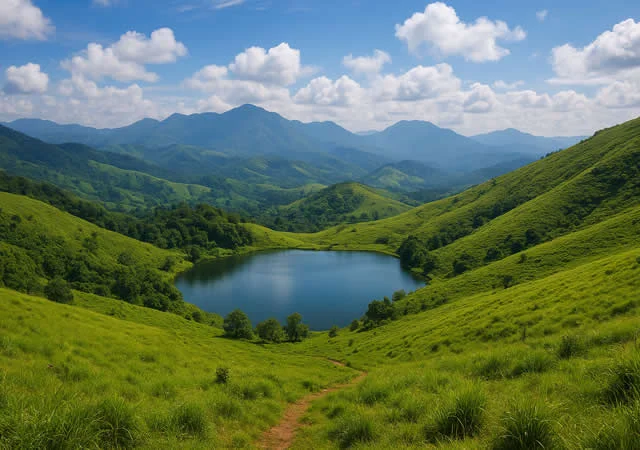
Ilaveezha Poonchira is the kind of place people discover by word of mouth rather than guidebooks. This scenic valley, cradled between three hillocks near Kanjar in Kottayam district, offers something increasingly rare: genuine quiet and unobstructed views of the sky.
One of the most magical seasons to visit is during the monsoon, when rain transforms the valley into a shimmering, mirror-like pond. The hills surrounding the basin seem to bloom with wildflowers, and mist drapes the entire area in a soft, otherworldly haze.
The terrain forms a natural bowl, surrounded by the peaks of Mankunnu, Kodayathoormala, and Thonippara. What sets it apart from other highland viewpoints in Kerala is the openness. There are no dense forests blocking the horizon, no commercial clutter, just rolling grasslands, distant villages, and a sense of space that makes it popular with sunrise chasers, trekkers, and anyone looking to escape crowds.
Understanding Ilaveezha Poonchira
The name “Ilaveezha Poonchira” translates roughly to “flowered valley where no leaves fall”. Local legend says that no trees shed their leaves here, though the reality is simpler: the valley is mostly open grassland with scattered low vegetation rather than dense tree cover.
The geography is distinctive. The valley sits at an elevation of around 900m (2,950 feet), surrounded on three sides by higher hills. Mankunnu, Kodayathoormala, and Thonippara form a protective ring, creating a microclimate that’s slightly cooler and often mistier than the surrounding areas. The fourth side opens up, offering panoramic views across lower-lying regions.
This bowl-shaped terrain gives you unobstructed views of the sky, which is why sunrises and sunsets here feel particularly expansive. The horizon stretches in all directions, and there’s nothing to interrupt the sight of light spreading across the landscape.
The unique terrain is the main draw. Unlike viewpoints perched on cliff edges, Ilaveezha Poonchira feels like you’re standing at the bottom of a vast natural amphitheatre, with hills rising around you and the sky opening above.
Panoramic views extend across the surrounding hills, with glimpses of villages, small lakes, and agricultural land in the valleys below. On clear days, the visibility stretches for kilometres, with layers of ridges fading into the distance.
The clear night skies here are excellent for stargazing. With minimal light pollution and high elevation, the stars appear bright and numerous. If you’re willing to make the drive after dark, bring a blanket and spend some time looking up.
Sunrise & Sunset Points
The wide horizons make both sunrise and sunset memorable. In the morning, light gradually fills the valley, burning off mist and revealing the landscape in stages. The colours range from soft pinks and oranges to brighter golds as the sun climbs higher.
Sunsets bring warm tones that spread across the sky and reflect off the hills. The light changes quickly, and photographers appreciate the range of conditions within a short window. Even if you’re not photographing, just watching the day end from this vantage point is worth the journey.
Valley Landscape
The valley itself is covered in open grasslands and rolling ridges. The terrain undulates gently, creating subtle variations in elevation that add depth to the landscape. It’s quiet here, with few sounds beyond wind moving through the grass and occasional bird calls.
The environment is ideal for slow exploration. You can walk across the grasslands, follow informal trails to higher points, or simply sit and take in the surroundings. The lack of development means the experience feels closer to encountering the landscape as it is, without much intervention.
Seasonal Beauty
Post-monsoon months, from October to February, bring the most vibrant greenery. The grass is lush, the air is crisp, and the skies are often clear. Misty mornings are common during this period, creating atmospheric conditions that soften the landscape and add layers of depth.
During the monsoon itself, from June to September, the valley becomes intensely green and small waterfalls appear on the surrounding hillsides. However, the terrain can be slippery, mist often limits visibility, and the access roads require careful driving. If you visit during this season, prepare for wet conditions and changing weather.
Summer months, from March to May, are warmer but still comfortable due to the elevation. The grass takes on golden tones, and the light becomes harsher, though early mornings and late afternoons remain pleasant.
Why Visit Ilaveezha Poonchira?
- Breathtaking Panoramas: From the mountaintop, you get sweeping views over multiple districts — Kottayam, Idukki, Ernakulam, Alappuzha and more. On clear mornings, sunrise and sunset moments are pure magic.
- Trekking and Adventure: Gentle trekking trails wind up the hills, giving both beginners and seasoned walkers a chance to explore.
- Mystical Monsoon Landscapes: As cloud cover moves in and fills the valley, the environment becomes surreal — the pond comes alive, rivulets flow, and the hills glow in greens and grays.
- Photography & Bird Watching: The high vantage points, mist, and wide-open vistas make this place a photographer’s dream. Birdwatchers can spot a variety of species in this serene habitat.
- Cultural & Spiritual Vibe: Beyond nature, the mythic associations with the Mahabharata and sage-stories make this a place to reflect, wonder and connect with Kerala’s deep cultural roots.
Spread across thousands of acres, the valley undergoes a breathtaking transformation when the monsoon arrives. As Kerala welcomes the season’s first torrential rains, Ilaveezha Poonchira seems to rejoice, filling up to become a vast, shimmering lake. Mist sweeps in from the hills, clouds hang low, and the once-dry basin turns into a dreamlike water world. This natural spectacle is one of the most extraordinary monsoon experiences in Kerala — a moment where the land, sky and water merge into a single canvas of soft blues and greens.
From the cliff edges and hilltops, the panoramas stretch endlessly across multiple districts. Sunrise paints the valley in warm gold, while sunset dips everything in shades of rose and purple. Standing at the summit during these magical hours feels like living inside a dream, with floating clouds at arm’s reach and rolling hills fading into the horizon.
Activities & Experiences
Multiple trails lead from the valley floor to the surrounding hilltops. The treks are moderate in difficulty, suitable for beginners with basic fitness. Most trails take 30 to 45 minutes to reach viewpoints on the higher ridges, where you get elevated perspectives over the valley and beyond.
The paths aren’t always clearly marked, so it helps to have someone local guide you or stick to the more obvious routes. Wear proper footwear, as the grass can hide uneven ground and rocks.
The approach to Ilaveezha Poonchira involves curvy mountain roads with frequent viewpoints. The drive itself is part of the experience, particularly for those on motorbikes or in cars who enjoy winding routes through highland terrain.
Road-trippers often stop at multiple points along the way to take photos or simply appreciate the views. The roads are generally in decent condition, though they narrow in sections and require attentive driving.
Panoramic landscapes, dramatic clouds, and night-sky shots are all within reach here. The open terrain provides foreground options with the rolling grasslands, while the surrounding hills and distant valleys create layers for composition.
Early mornings and late afternoons offer the best natural light. Cloud movements add dynamism to the sky, and when mist rolls through, the atmosphere becomes moody and textured. For night photography, the clear skies and lack of artificial light make star trails and Milky Way shots feasible with the right equipment.
Picnicking & Relaxed Outings
The open spaces make Ilaveezha Poonchira ideal for picnics and long, peaceful breaks. There’s room to spread out, and the quiet environment encourages relaxation. Compared to more developed hill viewpoints, this feels less commercial and more like a natural retreat.
Bring your own food and drinks, as facilities are minimal. The experience is better suited to those who enjoy self-sufficient outings rather than expecting amenities on-site.
Best Time to Visit
October to February offers the most pleasant weather and clearest views. Temperatures range from cool to mildly warm, and the post-monsoon greenery is at its peak. This is the best period for trekking, photography, and general sightseeing.
Early mornings, between 6am and 8am, provide soft light, mist, and fewer visitors. If you’re aiming for sunrise, factor in the drive time; the roads can take longer than expected if you’re unfamiliar with them.
Late afternoons, from 4pm onwards, are ideal for sunset viewing. The light becomes warm, and the temperature cools down, making it comfortable to spend time outdoors.
The monsoon, from June to September, brings lush landscapes but also challenges. Terrain becomes slippery, mist often reduces visibility, and rain can make access difficult. If you visit during this period, exercise caution on the roads and trails, and be prepared for sudden weather changes.
How to Reach
Ilaveezha Poonchira is accessible from several nearby towns. It’s approximately 25km (16 miles) from Kanjar, 40km (25 miles) from Erattupetta, and about 52km (32 miles) from Pala. The roads wind through hills and agricultural areas, with the final stretch climbing into higher terrain.
Private vehicles, taxis, and local jeeps are the common means of reaching the valley. The roads are narrow in places and involve hairpin bends, so drive carefully, particularly during or after rain. Jeeps operated by locals are available from Kanjar and other nearby points if you prefer not to drive yourself.
The nearest railway station is Kottayam, roughly 60km (37 miles) from Ilaveezha Poonchira. From Kottayam, you can hire a taxi or take a bus towards Kanjar and then arrange local transport for the final stretch.
The nearest airport is Cochin International Airport, approximately 115km (71 miles) away. The journey by road takes about 3 to 3.5 hours, depending on traffic and road conditions.
Facilities for Visitors
Facilities at Ilaveezha Poonchira are minimal, which is part of its appeal but also something to plan for. Small food stalls and local tea shops operate at base points, offering basic refreshments like tea, coffee, and light snacks. Don’t expect elaborate meals; these are simple roadside setups.
Basic parking areas are available, though they’re informal rather than organised lots. During weekends and holidays, finding space can be challenging as the site grows more popular.
There are no proper toilets or amenities on-site, so it’s wise to use facilities at nearby towns before making the final ascent. Carry sufficient water, snacks, sun protection, and any other essentials you might need during your visit.
Nearby Attractions
- Illickal Kallu is approximately 30km (19 miles) from Ilaveezha Poonchira, offering dramatic rock formations and valley views. The two sites work well together as part of a day trip.
- Marmala Waterfall is about 20km (12 miles) away, a seasonal waterfall that’s most impressive during and after the monsoon.
- Malankara Dam is roughly 35km (22 miles) from the valley, providing water views and a peaceful setting for a short break.
- Vagamon, about 40km (25 miles) away, is a more developed hill station with meadows, pine forests, and multiple viewpoints. It’s a popular combination with Ilaveezha Poonchira for a full-day hill-country itinerary.
- Poonjar Palace is around 40km (25 miles) from the valley, a historic palace with traditional Kerala architecture and royal artefacts worth exploring if you’re interested in local history.
Tips for Visitors
- Carry water, snacks, and sun protection. Facilities are limited, and you’ll want to be self-sufficient during your visit. The sun can be strong even when temperatures feel cool due to the breeze.
- Wear comfortable trekking shoes. The grasslands hide uneven terrain, and if you’re planning to explore the trails to higher points, proper footwear makes a significant difference.
- Visibility can drop quickly due to sudden mist. If clouds roll in, visibility can reduce to just a few metres within minutes. Wait it out if possible; conditions often improve after 15 to 20 minutes.
- Mobile network coverage may fluctuate in some spots. Don’t rely entirely on navigation apps; ask locals for directions before the final stretch, or have offline maps ready.
- Avoid visiting late at night unless you’re experienced with hill driving and confident about the route. The roads are narrow, poorly lit, and can be challenging in the dark.
Responsible Travel
Keep the valley clean. There are no bins or waste management facilities, so carry all waste back with you. Plastic bottles and food wrappers are unfortunately common litter here, and maintaining the site’s natural beauty depends on visitor responsibility.
Avoid loud music or noise. The quiet is one of Ilaveezha Poonchira’s defining features, and disrupting it diminishes the experience for everyone, including wildlife that inhabits the area.
Stick to marked paths and avoid disturbing vegetation. The grasslands and hillsides support local ecosystems, and trampling indiscriminately contributes to erosion and habitat damage.
Support local vendors and jeep operators. These small businesses depend on visitors, and your spending helps ensure that local communities benefit from the growing interest in the area.
A Peaceful Panoramic Escape
Ilaveezha Poonchira offers a different kind of hill experience, one that prioritises space, silence, and open views over amenities and infrastructure. It’s perfect for travellers who appreciate landscapes for what they are rather than what’s been built around them.
Pair it with Illickal Kallu or Vagamon for a full-day itinerary through Kottayam’s hill country, or visit it on its own for a quiet retreat. Either way, the valley’s calm atmosphere and panoramic horizons make it a memorable stop that feels genuinely removed from the everyday.
In every season, the valley offers something unforgettable but when the rains arrive and the hills disappear into clouds, Ilaveezha Poonchira becomes nothing short of a dream floating above Kerala.