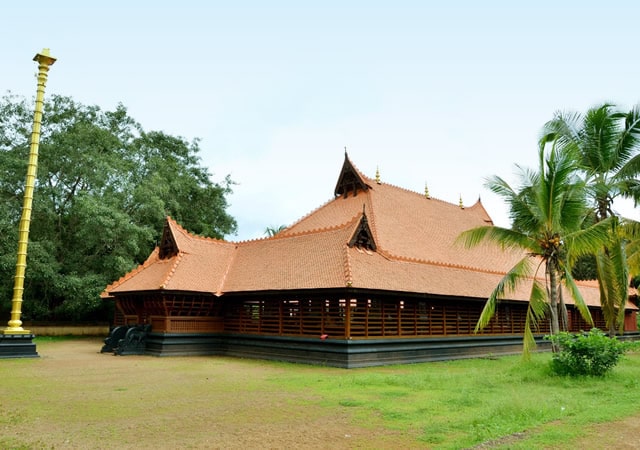
Kerala Kalamandalam, India’s premier academy for the classical performing arts, a cultural beacon that draws both curious travellers and earnest students alike.
Nestled on the gentle banks of the Bharathapuzha River in Cheruthuruthy, in the Thrissur district, lies a place where art lives and breathes itself into every gust of wind, every footstep on wooden floors, and every whispered recitation of ancient stories.
A Birth to Revive
In the early decades of the 20th century, many of Kerala’s classical art forms – Kathakali, Koodiyattam, Mohiniyattam – were waning, their traditions slipping beyond living memory. In this climate, the poet Vallathol Narayana Menon joined hands with Mukunda Raja in 1927 to form a society dedicated to reviving these art forms. Their vision grew, and in November 1930, Kerala Kalamandalam was inaugurated. It found its permanent home by 1936 in Cheruthuruthy, on land donated by the Maharaja of Cochin.
Kalamandalam evolved from a cultural revival society to a training institute following the gurukula tradition – a residential model where students live and learn under the same roof as their teachers.
In 2006 it was declared a “Deemed University for Art & Culture”, and in 2010 it earned an ‘A’ category status from the University Grants Commission.
A Living Museum of Movement, Gesture, Voice
Visiting Kalamandalam is not like going to a museum where one gazes behind glass. Instead, one steps into a living theatre of gesture, rhythm, expression and disciplined practice. The grounds are interspersed with training halls, performance spaces, quiet courtyards, and the sacred Koothambalam – the traditional temple theatre, built in the spirit of ancient architectural acoustics and ritual aesthetics.
Here, you will find students practising Kathakali – the dramatic dance-drama of Kerala, with painted faces, elaborate costumes, heavy masks, and precise, codified facial expressions. On another floor, Mohiniyattam dancers glide through gentle movements; Koodiyattam actors recite Sanskrit verses in timed gestures; Thullal, Bharatanatyam, Nangiar Koothu and traditional percussion instruments like chenda, maddalam, mizhavu echo through the air in practice rooms.
If you’re visiting as a tourist, try to time your visit to coincide with a performance evening. As dusk falls, the Koothambalam comes alive with chants, percussion, lamps, and dancers who seem to dance in the thresholds of myth and reality. The hush of the courtyard, the glow of oil lamps, the rhythmic beat of drums – they all conspire to transport you across time.
A Matter of Pride
For Keralites, Kalamandalam is a living shrine of identity – a place that safeguards the state’s most delicate cultural treasures. It’s a place where children from villages come to dream of mastering an art form that once risked obscurity. The sense of pride in seeing global recognition, students from other states or countries, and festivals held on its grounds is immense.
For international travellers, Kalamandalam offers more than performance: it offers context, narration, technique. Outside the typical “see and move on” stops, a stay here turns into a cultural immersion.
You might walk the verandas at dawn, hear distant chants from rehearsal halls, see students polishing instruments or applying makeup, talk to teachers about the logic of a mudra (hand gesture), or even sit quietly in a class observing how a syllable is elongated, a facial muscle tightened, or a foot placed just so.
Tips for Visiting
- Timing: Performances are best in the evenings; plan to arrive earlier to see rehearsals.
- Respect the space: Kalamandalam is a live learning site. Keep noise low, avoid flash photography during performances, and follow any rules given by guides.
- Guided walks: Seek guided introduction tours if offered, to understand the architectural symbolism, the instruments, costumes and narratives.
- Stay nearby: Cheruthuruthy and the surrounding villages offer quiet guesthouses or homestays. Waking early to hear morning prayers or chants in the campus is a magical experience.
A Journey into Kerala’s Artistic Soul
- Cultural depth: It is not just another ‘attraction’. It’s a functioning institution where art is both preserved and taught.
- Emotional resonance: You’ll feel the weight of centuries of tradition, the patience it takes to master these forms, and the humility in learning.
- Photographic richness: The architecture, costumes, lighting, and expressions provide striking visuals – without needing to turn the place into a spectacle.
- Bridging worlds: For Kerala locals, it is home. For outsiders, it is a gateway into Kerala’s artistic soul.